Friday, September 7, 2018

The (Almost) Battle Between New Orleans and … Kentucky?

Did you know that in 1798, a group of Kentuckians—so aggravated that their only access to move their goods through the Mississippi River would be shut down by Spain—considered to secretly march down to New Orleans and take it by force?   It was called the Spanish Conspiracy.

It all started in 1784.   The Spanish government closed the lower Mississippi River to the Americans, preventing them from trading their goods in New Orleans.   Angry Kentuckians blamed the US government for not doing enough to help the situation.   This caused several citizens to consider breaking away from the US.   At the same time, France secretly wanted to start the process of obtaining its old colony back again by whatever means.   France was also keenly aware that Kentuckians desperately needed access to markets down-river and the Gulf of Mexico for its products.   But Spain saw an opportunity to stem the flood of Americans into their territory.  Their solution was to convince Kentucky to become part of Spain. If they could pull it off, a Spanish-supported Kentucky would be a barrier to American expansion across the Mississippi River. The race for Kentucky was on.

-- Spanish Attempt --

James Wilkinson
Kentuckian General James Wilkinson had even bigger ideas.  He cooked up a plan, one that would make him king of a new nation.  He secretly met with Louisiana Governor Miro in New Orleans in the hopes of convincing him to form a Spanish alliance; an exclusive one that only allowed his goods to pass through, tax free.    He convinced Miro to keep the river closed to all other Kentuckians, which would cause dissent amongst the people.   He knew they would blame Washington.  Once the state seceded, he would announce a new nation, a Nation of Kentucky, aligned with Spain.   Back in New Orleans, Miro was weary of Kentuckians invading Louisiana.   So, Miro sent Natchez Governor Manuel Gayoso to do some undercover work in Kentucky, without arousing American suspicion. 


Gov Miro

Wilkinson eagerly betrayed other Americans who had similar ambitions in the West in the name of protecting Spanish security. He also supplied the names of VIPs in Kentucky and Tennessee who could be corrupted by Spanish gold. Wilkinson himself enjoyed a Spanish pension of $2000 yearly beginning in January 1789, with the payments disguised as profits on tobacco sales in New Orleans.  Yet, Miro saw through his scheme.  When Wilkinson loaded a flat boat with tobacco, hams, butter and flour and started fearlessly on a 1400‑mile floating test voyage to New Orleans, his materials were seized in the city.  Miro stated, “I am aware that it may be possible that his intention is to enrich himself at our expenses with promises and hopes which he knows to be vain.”   It seems Miro knew Wilkinson had no plans to align with Spain, but instead, to break away as an independent nation.   In a sly turn, Miro used the promises of future alliances to prevent a Kentuckian invasion.    (Many people think that Wilkinson’s plan was to openly advocate an alliance with Spain in order to force the US to admit them into the Union.  It must have worked since Kentucky achieved statehood in half the time it took for Vermont.)

-- French Attempt --
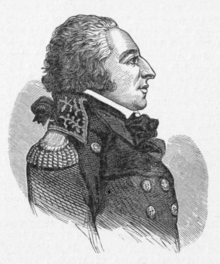

Edmond-Charles Genêt.png
Edmond Charles Genet
By 1792, France had entered a quasi-Cold War against the Americans shortly after their independence was gained and a few officials tried to align the country with potential disenfranchised American territories; territories that seemed eager to break away from the U.S.   In 1794, even the French minister to the US, Edmond Charles Genêt, sent spies into Spanish Louisiana to drum up insurrection support by distributing fliers to the citizens of Louisiana to rise up against Spanish control.  The fliers stated such things like “Compare your situation that of your friends — the free Americans. Look at the province of Kentucky, deprived of outlets for its products, and yet, …, rapidly increasing its population and wealth, … a prosperity which causes the Spanish government to tremble.”  It goes on to state, “The peopling of Kentucky has been the work of a few years. Your colony, although better situated, is daily losing its population, because it lacks liberty.”   This propaganda caused fear in the Spanish officials of Louisiana, particularly Francisco Luis Hector, Barón de Carondelet. 

At the same time, Genet speculated that western settlers, particularly those in Kentucky and Tennessee could be persuaded with “innumerable advantages” from the French government if they would only separate from the US, help invade Louisiana, and form an alliance under the protection of France.   Apparently, it worked well enough in the West and even the South to get men to consider invading Louisiana.   Armed bands had been gathered on the southern frontier of Georgia, and even a large body of Creek warriors was in readiness to join the invaders. It was feared at the same time, that an attack would be made from the Ohio settlements, and that the spring flood of the Mississippi would bring down the enemy, borne swiftly onward by the rising waters of that river.

When rumors of the militia buildup reached New Orleans, Carondelet braced for impact.  He formed a militia of 6000 men for the sole purpose of thwarting any attack.  Simultaneously, he loosened some of the trade restrictions he had imposed on the Americans regarding passage on the Mississippi.  He and Mire felt their job was to “win over that restless and energetic population to the dominion of Spain.”   The Georgia governor stepped in to quell the situation.  Even Washington stepped in to prevent invaders from Ohio from considering an attack.   Genet’s subordinate in Kentucky, Auguste de la Chaise, abandoned all hopes and wrote a discouraged letter stating, “Unforeseen events…, have stopped the march of 2000 brave Kentuckians, who, strong in their courage, …, and convinced of the brotherly dispositions of the Louisianians, waited only for their orders to go and take away, …from those despotic usurpers, the Spaniards.”  It seemed for now, there would be no invasion from Kentucky and Miro left Louisiana for Spain.

-- Spanish Attempt, Again! --
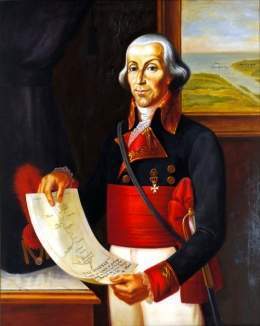
Image result for Francisco Luis Hector, barón de Carondelet
Francisco Luis Hector, barón de Carondelet
However, as soon as the fear faded, Carondelet imposed restrictions on American trade along the Mississippi again.  This time, he sent his own agents into Kentucky to “tempt the people into a separation from the United States and an alliance with Spain, by which the much desired outlet of the Mississippi would be secured to them.”   This was an attractive offer.  Those in Kentucky were tired of commerce obstacles on the Mississippi River that the US government couldn’t remove.   Also, Pennsylvania had just placed a tax on whisky coming from Kentucky, so overland shipments through the Appalacian mountains were now far more expensive.    Therefore, Carondelet sent emissaries who worked hard to “heat and exasperate the different parties existing in Kentucky.”   Spain thought now was their chance.  So, they sent in Colonel Gayoso de Lemos of Natchez and Thomas Power.

Power was an Englishman, but a Spanish subject.   Carondelet thought he was a “fit subject to be employed on the hazardous mission of sowing the seeds of sedition in the West”.  Power met with some of the men that would carry out the plot.   He distributed a letter to them telling them that once they formally declare independence from the U.S., Spain would take possession of Fort Massac and form a new government, furnished by Spain.  To entice these Kentuckians to go through with this dangerous mission, Spain gave Power $10,000 to bring up the river, “concealed in barrels of sugar and bags of coffee”, as tempting offers to smooth any difficulties along the way. 

Wilkinson, still one of the most influential Kentuckian leaders, listened intently as Power flattered him, saying things such as “Can a man of your superior genius prefer to be a subordinate, a contracted position as the commander of the small and insignificant army of the United States, [versus] the glory of being the founder of an empire… the liberator of so many millions of his countrymen… the Washington of the West?”.    In Power’s viewpoint, who wouldn’t want to be the George Washington of the West?

Power went on to question his zeal, asking him “Have you not the confidence of your fellow citizens, and principally of the Kentucky volunteers? Would not the people, at the slightest movement on your part, hail you as the chief of the new republic?”   Wilkinson’s ego was lifted high and Power eagerly awaited to see what would happen.   In a last ditch effort to plead his case, Power exclaimed to Wilkinson , “The eyes of the world are fixed upon you; be bold and prompt; do not hesitate to grasp the golden opportunity of acquiring wealth, honors, and immortal fame.”

Gayoso and Power waited.    Time passed.  Any insurrection that was instilled in these countrymen eventually faded away.  To make matters worse for Power, Wilkinson had just been appointed Major-general of the United States and had less interest in declaring independence or worse, starting a war.   Any interest in a “Spanish Kentucky” disappeared when Jay’s Treaty of 1794 was signed.  Spain believed if they didn’t open up the Mississippi River to Americans, both the US and Britian would declare war.   Gayoso pleaded to reverse the decision but Carondelet had made up his mind. 


  1. http://penelope.uchicago.edu/Thayer/E/Gazetteer/Places/America/United_States/Louisiana/_Texts/GAYHLA/4/6*.html
  2. http://penelope.uchicago.edu/Thayer/E/Gazetteer/Places/America/United_States/Louisiana/_Texts/LHQ/1/2/Wilkinson/1*.html

Saturday, November 16, 2013

Ignacio de Balderes

Ignacio de Balderes 
Attributed to José Francisco Xavier de Salazar y Mendoza 
c. 1790 
Oil on canvas, 45 1/2 x 33 1/2 inches 
Louisiana State Museum, Gift of Mr. Harvey Truxillo, M141.2
Born in Salamanca, Spain, in 1757, Balderes entered military service as a private at the age thirteen as a private. He was sent to West Florida to work as a surveyor and rose through the ranks. As a sergeant in 1779, he earned distinction by capturing a post at Pass Manchac during the Battle of Galvez-Town. Balderes was knighted by the king of Spain and given a large land grant near Pensacola. 

Salazar painted many of Colonial Louisiana's prominent citizens, figures associated with the government, the military, and the church. Well-versed in the late Baroque style popular in Spanish colonies, Salazar was the first significant painter to work in New Orleans

In the early 1790s, Balderes was a Sub-Lieutenant of the Grenadiers, Second Battalion of the Regiment of Louisiana, and commander at Balize, an outpost guarding the mouth of the Mississippi River. The single epaulette - which is in the Museum's collection - indicates his rank as a lieutenant. Balderes was respected for his zeal and leadership. Francisco Bouligny, his commander, wrote "I believe it is always fitting to provide officers of well-known courage, good conduct, assiduity and who are intelligent" with promotion when he became adjutant-major of the Third Battalion in 1793. Balderes eventually reached the rank of captain in 1798, and died in 1815 at the age of fifty-eight.

His son Antoine became a lieutenant as well.  His children married into many families of Louisiana.

References
1. Diocese of Baton Rouge Catholic Church Records, Department of Archives, v3, p66, Lafayette Public Library, 301 W. Congress St., Lafayette, LA 70501.

2. Holmes, Jack D. L., Honor and Fidelity: The Louisiana Infantry Regiment and the Louisiana Militia Companies, 1766-1821, Birmingham, AL, 1965, p92, University of Louisiana at Lafayette Edith Garland Dupre Library, PO Box 40199, Lafayette LA 70504.

3. Charles E. Nolan, editor, Sacramental Records of the Roman Catholic Church of the Archdiocese of New Orleans, Vol 3, 1772-1783, p12, Lafayette Public Library, 301 W. Congress St., Lafayette, LA 70501, LA 929.376335 WOO.

4. Churchill, C. Robert, Officers, Spanish and Natives of Louisiana, serving under Gen. Don Bernardo de Galvez in his Campaign Against the British, 1779, 1780, 1781, p11, Tulane University Library, Howard-Tilton Memorial Library, 7001 Freret St, , New Orleans, LA 70118, Ph:(504) 865-5605.

5. Granville W Hough, Spain's Louisiana patriots in its 1779-1783 war with England during the American Revolution, Midway City, CA, SHHAR Press, 2000, p29, Tulane University Library, Howard-Tilton Memorial Library, 7001 Freret St, , New Orleans, LA 70118, Ph:(504) 865-5605.


Tuesday, July 23, 2013

Genealogía y heráldica

Alot of information regarding heraldry and some genealogy in Spain.

See: http://www.bne.es/es/Micrositios/Guias/Genealogia/ (SPANISH)

EL BLASÓN ESCRITO: LA HISTORIA DE LOS LIBROS DE HERÁLDICA

For those researching Spanish heraldry, coat of arms, crests and such, this document explains alot.  There are numerous books on heraldry. Some are theoretical studies on the concept of heraldry, the notions of shields, their interpretation, their symbols and terminology, which is already fixed and is typical of this area. Others are codes of shields, with explanation of its components, which contains sources studied or families who own them.

Keep in mind that many genealogy books include extensive information on heraldry. So many sources cited in the study of genealogy also serve to begin in heraldry.

To become familiar with these books, nothing better to start with the text of José Antonio Vivar del Riego.

EL BLASÓN ESCRITO: LA HISTORIA DE LOS LIBROS DE HERÁLDICA by José Antonio Vivar del Riego

Thursday, December 13, 2012

Spanish Louisiana Books on FamilySearch

Looking for books regarding Spanish Louisiana history? Family History Books is a collection of more than 40,000 digitized genealogy and family history publications from the archives of some of the most important family history libraries in the world. The collection includes family histories, county and local histories, genealogy magazines and how-to books, gazetteers, and medieval histories and pedigrees.

See: http://books.familysearch.org/primo_library/libweb/action/search.do?mode=Advanced&dscnt=0&dstmp=1355268663641&vid=FHD_PUBLIC

Thursday, December 15, 2011

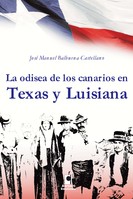
The Odyssey of the Canaries in Texas and Louisiana


Jose Balbuena's book "Odyssey of the Canary Castilian Texas and Louisiana", is not only a publication about facts of this historical epic of the Canarian colonial America, but also serves as a picture of their offspring born in this large American territory, which have expressed pride, heritage, have been able to convey generosity. Its author is a well known and excellent journalist who joined the newspaper The Province in 1972, writing many interesting features, interviews and chronicles of travel, making it one of the first journalists of the Canary Islands in the dissemination of specialized tourism issues.


Friday, August 19, 2011

Index to the Vicente Sebastián Pintado Papers

A Finding Aid to the Collection in the Library of Congress.

Surveyor general of Spanish West Florida. Correspondence, bills of sale, court
transcripts, testimonies, surveys, notebooks, plats, land grants, maps, petitions, and other papers
relating principally to Pintado's duties as alcalde, commandant, and surveyor general.


Subjects
Deeds--Alabama.
Deeds--Florida.
Deeds--Louisiana.
Deeds--Mississippi.
Land grants--Alabama.
Land grants--Florida.
Land grants--Louisiana.
Land grants--Mississippi.
Land tenure--Alabama.
Land tenure--Florida.
Land tenure--Louisiana.
Land tenure--Mississippi.
Real property--Alabama.
Real property--Florida.
Real property--Louisiana.
Real property--Mississippi.
Places
Vicente Sebastián Pintado Papers 2Alabama--Maps, Manuscript.
Alabama--Surveys.
Florida--History--Spanish colony, 1784-1821.
Florida--Maps, Manuscript.
Florida--Surveys.
Louisiana--Maps, Manuscript.
Louisiana--Surveys.
Mississippi--Maps, Manuscript.
Mississippi--Surveys.
Spain--Colonies--America.

Wednesday, July 6, 2011

Looking for old maps of the Mississippi River, New Orleans, and surrounding areas? Check out the Norman B. Leventhal Map Center at the Boston Public Library. They are dedicated to the creative educational use of its cartographic holdings, which extend from the 15th century to the present, including many Louisiana maps.

See: http://maps.bpl.org

Tuesday, December 7, 2010

Jose's Malaga Research

For those interested in the Malaguenos in Spain which sailed to Louisiana and founded New Iberia, José Manuel de de Molina works on this research in Spain and can be contacted. On his website he states:

"My webpage I offer my professional services as Historian, Archivist and Genealogical Professional. I have a wide experience and a comprehensive academic studies, providing legal services according with Spanish Law. You can read the different pages in the left menu including my references and activities tracing history and genealogy in Lousiana to Spanish ancestors. If you are looking for your family line in Spain and you need a professional genealogist service, I can help you. "

See: http://www.demolina.es/ (Spanish and English)
Email: jmdemolina@darrax.es

Friday, December 3, 2010

In Search of Galveztown

Rob Mann is Louisiana’s Southeast Regional Archeologist with a professional expertise in historical American archeology. He can identify the teacup and other artifacts unearthed from the Cambre greensward— fragments of French faience and coarse Spanish earthenware, brick rubble, nails, chunks of coal, pieces of bone— as evidence of daily life of the residents of Galveztown, a Spanish colonial community perched at the confluence of Bayou Manchac and the Amite River between 1779 and
1806.

See http://maryannsternberg.com/files/Galveztown.pdf (PDF)

Saturday, August 7, 2010

NOLA.com: Delacroix, LA


A four part series on the Canary Islanders of Delacroix Island, Lousiana.


Today Delacroix and other fishing villages are either ghost towns, reclamation projects for sportsmen, or temporary boom towns for the BP disaster response. Some commercial fishermen still dock along the bayou, but they are commuters, driving in from communities on the protected side of the levees. Families that lived along the bayous for hundreds years have given up, chased away not just by the violence of recent storms, but the certainty of more to come. If there's new construction, it's largely by city anglers building recreational retreats.

See Part 1

See Part 2

See Part 3

See Part 4

Wednesday, April 28, 2010

Islenos on Dixiemania

During all of my research, I couldn’t help but ask myself time and again why so many Canarios had emigrated to Louisiana between 1778 and 1784. 2736 emigrants from the Canary Islands are officially recorded on the passenger lists of the ships, yet experts suggest a total of almost 4000 people. Today, there are approximately 40,000 Isleños, i.e. descendants of the Canarios, living in Louisiana (and some documents even claim that there are 70,000!).

It is a well known fact that a lot of them emigrated to Cuba, Uruguay, Mexico, Hispaniola and Venezuela (the last great wave of emigration to Venezuela took place between 1936 and 1945). But what made them go to Louisiana of all places?

See http://dixiemania.com/en/dixiemania/louisiana-los-islenos.html

Thursday, April 8, 2010

State Land Office Online Documents


These maps are based upon surveys taken in 1828-1830. They can be used to locate the property of Isleno ancestors and the Acadians who arrived in 1785 and settled just south of the Valenzuela district in what is now the Plattenville and downstream area. For example, the Valenzuela settlement can be found in Township 11 S, Range 14 E, west of the Mississippi River.

These documents include U.S. and State historical land title information, including information related to: Land Grants; all severance documents of U.S. and State public lands - which lists the first private owner; all U.S. Official Township Survey plats and field notes; the U.S. and State Tract Books - which are an index of all the other documents mentioned; Section 16 School Lands; State Patents; and numerous related documents.

See: http://1webfn.doa.la.gov/slodocs/SLO/home.asp

Tuesday, March 2, 2010

The re-launching of the Galveztown


The first planks of an exact replica of the famous brig were laid recently in a ceremony in Nereo, close to the Baños del Carmen, outside Malaga city. For those who do not already know this, the Galveztown was the ship commanded by Malaga hero Bernardo de Gálvez to capture the port of Pensacola in the 18th century.

Saturday, January 23, 2010

Saturday, December 26, 2009

Archive.org: Papeles procedentes

This is a web presentation of the Rosco Hill's book on the "Cuban Papers'" , a great reference work to find the file (Legajo) on a specific subject on the Spanish period in Louisiana. Gives a summary of what's contained in each file . Many of the microfilmed Legajos are to be found in the Hill Memorial Library at LSU.

See http://www.archive.org/stream/descriptivecatal00hill/descriptivecatal00hill_djvu.txt


Thursday, December 24, 2009

Mgar.Net: Isleños de Luisiana

Shortly after the conquest, the government of Castile and the Crown encouraged and subsidized the emigration of Canarians for colonization and settlement of America. The article discusses the Isleños Heritage & Cultural Society of St. Bernard as well as Gilbert C. Din's book "The Canary Islanders of Louisiana".

Monday, November 23, 2009


The Universidad de La Laguna contains the document "La Emigración del noroeste de Tenerife a América durante 1750-1830" (The Emigration from Northwest Tenerife to America during 1750-1830). Doctoral Thesis by Felix Rodriguez Mendoza of the Universidad de la Laguna in Tenerife, ISBN: 84-7756-596-1.


This is a large document (998 pages) which includes at the end a 67-page table of individuals who emigrated to America during this period. The table includes the town of origin, port, ship captain, name of ship and name of the person who loaned the money for the passage. The text of the thesis describes the reasons for the voyage


For the university, see http://www.ull.es/

For the document, see ftp://tesis.bbtk.ull.es/ccssyhum/cs163.pdf


Thursday, November 12, 2009

Vicente Sebastián Pintado - A Register of His Papers in the Library of Congress


Captain Vicente Sebastián Pintado, the royal surveyor for the Spanish government kept papers regarding the surveys and records of deeds and grants in Spanish Louisiana. After trading hands through other families, it eventually reached the Library of Congress. Here you can search through his material.


Tuesday, October 27, 2009

DIOCESE OF BATON ROUGE - Published Sacramental Records


The Department of the Archives of the Diocese of Baton Rouge is the repository of the sacramental records of the Catholic churches within the diocesan territory. Civil parishes included in the Diocese are: Ascension, Assumption, East Baton Rouge, East Feliciana, Iberville, Livingston, Pointe Coupée, St. Helena, St. James, Tangipahoa, West Baton Rouge and West Feliciana.The Department has published abstracts of its holdings of sacramental records. To date Volumes 1a through 22 have been published and are available for purchase. These books contain records of baptisms, marriages and burials dating back to the early records of the Parish of St. Charles-aux-Mines, Grand Pré in Acadia (1707-1748). There are many records of the Louisiana colonial period including those of St. Francis of Pointe Coupée (1722-1769). Volumes 1a through 22 contain all extant records from throughout the diocesan territory through 1900. In each volume the abstracts are listed in alphabetical order by surname. Volume 1b is the first volume to contain records of those without surnames.

http://diobrarchives.org/publications/diocese-of-baton-rouge-catholic-church-records/